

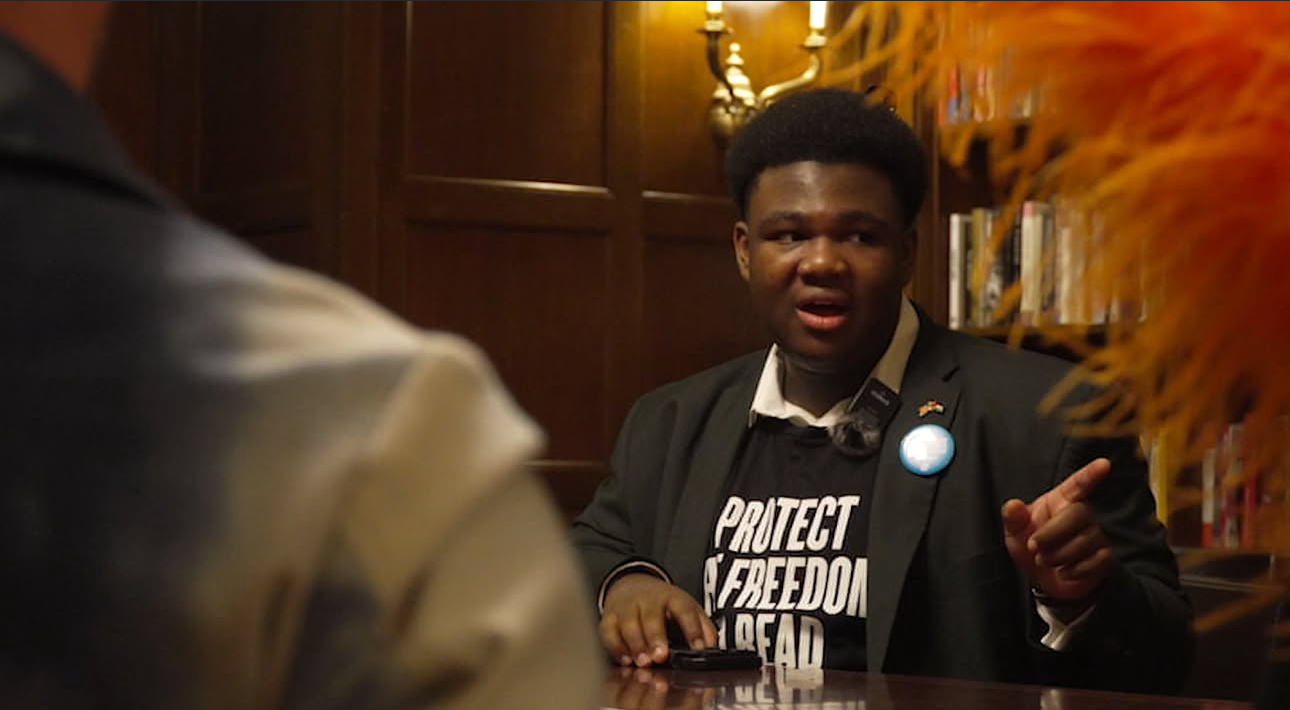
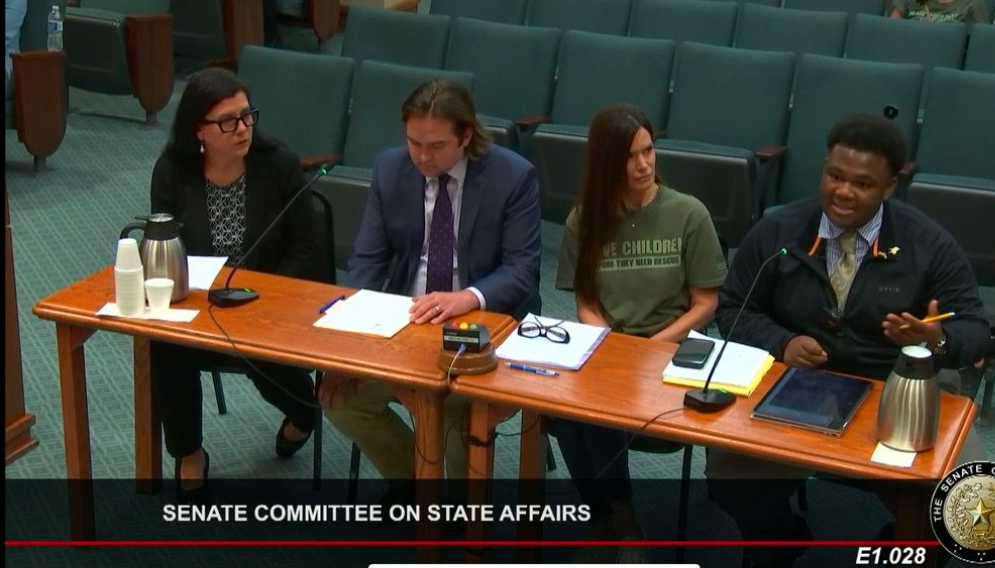
18-year-old Da’Taeveyon Daniels is a dedicated student activist from Fort Worth, Texas, whose passion for educational equity has led him from state legislatures to Capitol Hill to the forefront of a campaign registering 4,000+ high school seniors to vote across 10 states. Da’Taeveyon has mobilized thousands of students across the country through leading rallies, testifying before state committees, and building coalitions.
And Da’Taeveyon’s core belief? You can do it, too. His activism began as a freshman in high school when he joined the inaugural cohort of the National Coalition Against Censorship’s (NCAC) Student Advocates for Speech, where he fought against book bans in Texas and mobilized students to advocate for representation in literature.
Since then, he’s fostered collaboration among youth advocates and policymakers to drive tangible policy reforms, through leadership positions at Students Engaged in Advancing Texas (SEAT) and the Youth Legislative Action Center, and by serving as the youngest-ever member of NCAC’s National Advisory Council. Now as a founding leader of Students Organized for a Real Shot (SORS), Daniels is continuing his mission to protect public education and build genuine grassroots power.
NCAC was Da’Taeveyon’s catalyst, and now his goal is to ensure young people can begin their advocacy journeys with the support and platform to lead. We met with Da’Taeveyon to discuss the power of collective activism, the shared burdens Gen-Z faces, and how to take the first step in getting involved in your community.
CK: How has kindness shaped your approach to advocacy and leadership?
DD: I wouldn’t be in this work if someone wasn’t kind enough to bring me into this space and kind enough to guide me through. Kindness is always at the forefront of the organizing efforts that I pursue, it’s really about making sure that we’re able to resonate and empathize with people. We all come from different backgrounds, different identities, different intersectional identities. There are so many differences that could cause so many issues, but at the end of the day, I think we navigate that through kindness.
I’m in an organizing space that’s not necessarily traditional. I’m a young person in the education organizing sphere. So being in this space, there aren’t a lot of young people. Instances where kindness is intergenerational is something that’s been so powerful and poignant for me. It’s so many times where young people are in these spaces and they get so discouraged simply because there was no warm smile in the crowd or there was no welcoming embrace after getting up and speaking at a really large conference or gathering or even testifying. Kindness is a really big part of this work.
CK: What is your approach to making people feel seen and motivated to act, especially young people who may currently feel disempowered?
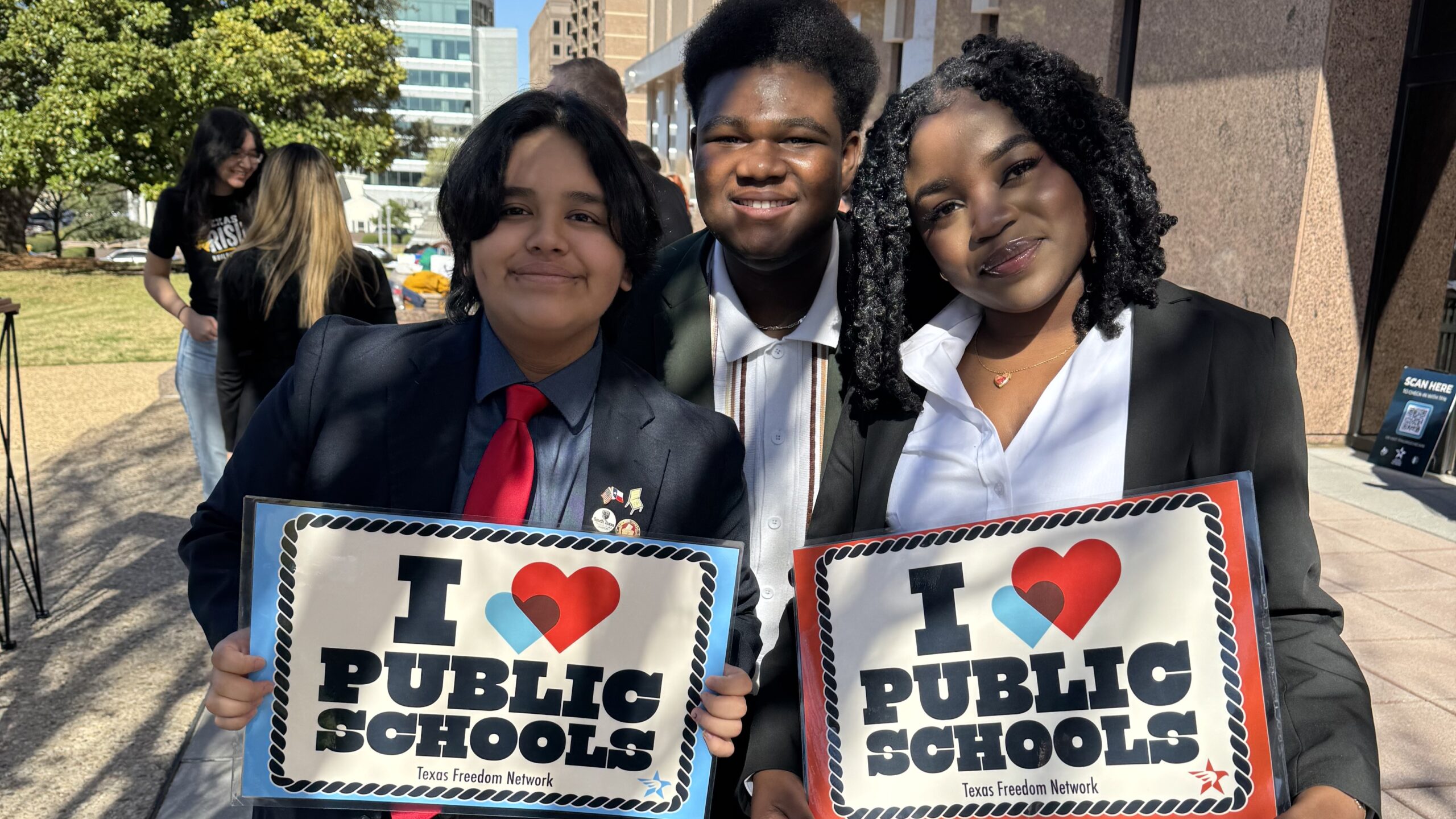
DD: It’s really about understanding that everyone has a story and being receptive to those stories. Being receptive to the communities that you’re engaging with, being receptive to the challenges that may arise, being receptive to the people who often disagree with you.
There are so many shared burdens that we experience as Gen Z, so I always find it very helpful to resonate in that with another young person. A lot of the young people that I bring into this fight come into it because they have this personal issue with what’s happening with the powers that arewithin the system. But we share that issue and share that power struggle.
For example, when I started organizing, the main reason that young people were starting to join my Student Advocates For Speech club was because they could not see narratives that represented who they were in our school library. And that was something that catalyzed my work. Being in that space, being able to share that burden with them was a community catalyst for us. It’s really about finding the many issues that exist for young people in this world and resonating with one another and building community to support and uplift one another around these issues.
CK: What are some common misconceptions adults have about youth activism, and how do you build trust across different youth movements?
DD: I find that a lot of adults feel that we’re just angry and we just have a lot of misplaced anger: anger with the system, anger with the country, anger with the politicians. And they just see that as pure rage instead of something that we’re actually honing into organizing strategy. Right now, we’re actually talking strategy. We’re actually talking about meeting with the lawmakers and getting young people in this room to have this conversation, getting young people up at a podium to testify and to speak, because at the end of the day, our narrative power is strong and that may come across as anger, but in truth, it’s passion and candor about these issues.
Even though so many generations before us have made such progress up until this point, the marker changes. Per generation, it changes. Our standards rise. Our humanity rises, and that requires progress, a change in the space, in the movement, in the community. And we have to continue working at that.
CK: Do you remember the moment you realized your voice could make a real impact? What did that feel like?
DD: I suffer from imposter syndrome a lot, being a young person while trying to balance the academia, the organizing, and a social life. There are so many spaces that I enter where I feel like I’m not really equipped to handle them. But I will say when I first realized and understood that my voice has power – when we were able to get 4,000 kids registered [to vote] across 10 different states in 10 months, that was something that was like, okay, we were able to hop on a Zoom call with this big organization and figure out how to coordinate voter registration in 10 states for literally $0. We were able to do something that powerful.
Being able to be in this space is such a blessing. This work has given me a badge of validity in the eyes of society that I don’t think I would have otherwise, because this is something that I’m so passionate about. That badge of validity speaks to the system that is actively changing when voices like mine and my colleagues are being able to be recognized in these spaces.
CK: What advice would you give to young people who want to start organizing?
DD: I found the National Coalition Against Censorship simply by chance, scrolling on social media and seeing that they were looking for student advocates for speech and looking to train young people to build a cohort of young change makers across the nation. And that was my catalyst of being able to enter this space. So a lot of it is chance of breaking the cycle and being able to find your one catalyst, but what I’m really trying to focus on and do is making sure that young people can enter these spaces without chance.
It’s just about being able to take that first step of courage and understanding that it’s okay to be a person in these systems and work with these systems in order to better your community. And once you step up, the ways are endless. We have literal computers in our hands at all times of the day. Just take a simple moment to figure out, is this something that I’m really passionate about? Find what piques your interest and insert yourself in the most genuine and honest way that you can with what works with your life, what works with your identity. I promise you there will be a welcoming space for you.
Then once you do that step, it’s really like you planted the seed. You get that email from change.org. Your petition has been signed. Take the final step. Share the link. Systems like that that are being built online are breaking down the barriers to being a changemaker.
CK: Can you share a bit more about your current work at Students Organized for a Real Shot (SORS)?
DD: We’re working right now in Texas and California, and we are building change at the most grassroots level. We do these things called Beyond the Engaged Few dinners. And these are things that happen directly in people’s backyards, in communities, at local restaurants, where we’re bringing young people and intergenerational partners, adults, grandparents, community leaders into the fold and just having a conversation.
These conversations from the guided aspect centers around what’s happened in this state’s legislature and what’s happened at the federal level and how will this affect us on the street, at the very local level, and how can we prepare our community and how can we rely on one another – this inner community relationship and perseverance, how can we build this up in order for it to sustain us to the next legislature.
We break down that barrier and we make sure that we’re listening to the narratives of the communities that we’re in, and we’re being driven by that. And once we go in and train a couple of young people and a couple of adults to kind of be these catalysts for these conversations, we kind of get back. We provide the support, the materials, but we let it flow naturally. And we compile that information and compile the narratives and the shared stories and the concerns.
CK: When you think about the future of public education, what do you hope it looks like for students like you and me and beyond?
DD: I have so much hope because I see the passion that I had and I’m seeing that en masse, meaning I’m seeing it in everyone. And that’s very hopeful, you know, as someone who’s been in this space for a little bit – or a rather long time for someone who’s only 18.
So many people are tired. And I feel like that sense of tiredness really tells us that people are feeling the impact of what’s been happening and what’s been boiling up. And now it’s finally reached the surface. And it just takes a few of those voices to actually bring more people into the fold to actually start implementing change.
If you look at history, there’s been so many student protests in colleges and high school. It’s like we really are following that framework and we know that that’s worked in the past. It is inspiring to know what’s worked in the past when things were harder. Things are only getting more inclusive and more people are getting braver and more inspired to act. I’m seeing more people sign petitions, which gives me even more hope. When there’s a collective of people across this nation doing that, when there’s millions of people signing a petition, when there are thousands of young folks speaking up at school boards, it really begs the question of change needs to happen and it needs to happen now. And I’m just really hopeful and excited.