

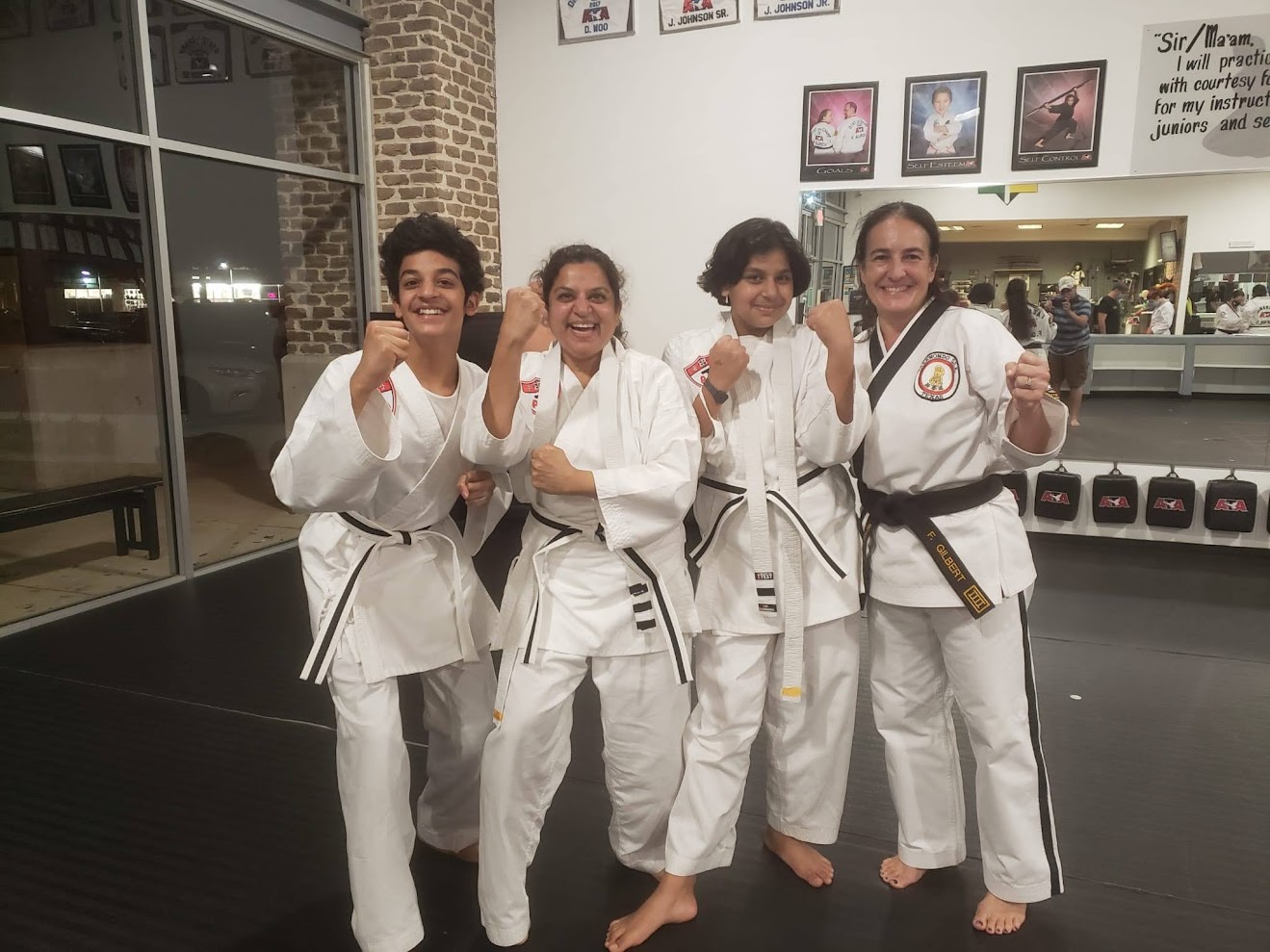
I started taekwondo in eighth grade because I wanted a physical activity that would also improve my self-discipline. My sister wanted to come with me, and my mom came, too. However, I was surprised to see that my mom didn’t come to drop us off and sit in the car; she put on a uniform and stepped onto the mat with us. At first, I worried it would feel awkward. However, when class started, our instructor treated my mom like any other beginner. Everyone gets corrected the same way, does the same warm-ups, and improves over time with effort.
Over time, taekwondo became a way for me to reset at the end of the day, especially when I was stressed about school. I often felt overwhelmed with deadlines and work, but training gave my mind a simple focus. When you’re practicing a form, your body has to pay attention to small details: where your foot lands, how your hips turn, and whether your guard is actually up or just vaguely floating. There’s no room for multitasking, which is incredibly helpful. You move, you breathe, you listen, you try again, and that rhythm helps regulate you for the time being. Your nervous system starts to believe you when you tell it that you can handle the next thing.
The best part, though, was having taekwondo be our thing. Having taekwondo in common gave my mom, my sister, and me a shared language to talk about at dinner. Instead of just vaguely sharing about our days, we said:
“Did you see how hard that new kick combo was?”
“I always forget about that jab in our form.”
“I think I’m finally getting that turn down.”
Having a shared hobby helped us relate to each other. Even when we disagreed on various things, we still had this space where we were on the same team with the same goal.
I also made friends in taekwondo that felt different from school friends. In the dojang, also known as the formal training hall, people see you mess up and get frustrated, yet they see you try anyway. They don’t judge, and their support feels real. There’s a special type of kindness that shows up in places where everyone is learning something hard at the same time. People stay a few extra minutes after class to help you remember a sequence, clap when you break a difficult board, encourage you when you are about to do a belt test, and much more. Those moments add up, and when you’re a teenager who often overthinks small mistakes, being in a community that treats mistakes as normal means the world.
By the time I was a senior in high school, taekwondo had been part of my life for over four years, and I could see how it had reshaped my mental health. It taught me emotional control. Because you can be nervous and still spar; you can be tired and still practice; and you can be overwhelmed and still take the next step if you slow down. Taekwondo anchored me, because no matter how messy the week felt, class had a beginning and end with progress throughout. And
because my mom and sister were doing it too, it also reminded me that I wasn’t carrying everything alone.
We earned our black belts the same year, my senior year of high school. I love our journey because we were three people with different schedules, different stress levels, and different bodies, yet we chose to stick with the same hard practice. The black belts mattered because they were a concrete marker of effort, but what mattered more was the slow accumulation of ordinary days when we didn’t feel like going and went anyway. Taekwondo supported my mental health through years of repetition and community, building my confidence when I kept showing up and kept improving. With my family, we struggled together and did the same hard movements, yet we had something good to talk about at the end of the day. This made everything worth it.