


I remember when my kindergarten teacher handed me a shiny iPad to do all my math and writing on. Restricted only by the school’s network, my classmates and I had almost no boundaries except to bring our iPads back the next day with a full battery charge.
Several years later, my parents handed me an even shinier iPhone, believing that being able to call me anytime was the safest option. Apart from a quick warning about stranger danger, I suddenly had access to talk to anyone, anywhere, with no idea where to find the brakes.
Before we start driving, we learn how to look for risks on the road. But when do we learn how to navigate online? What do we do when we encounter a hazard?
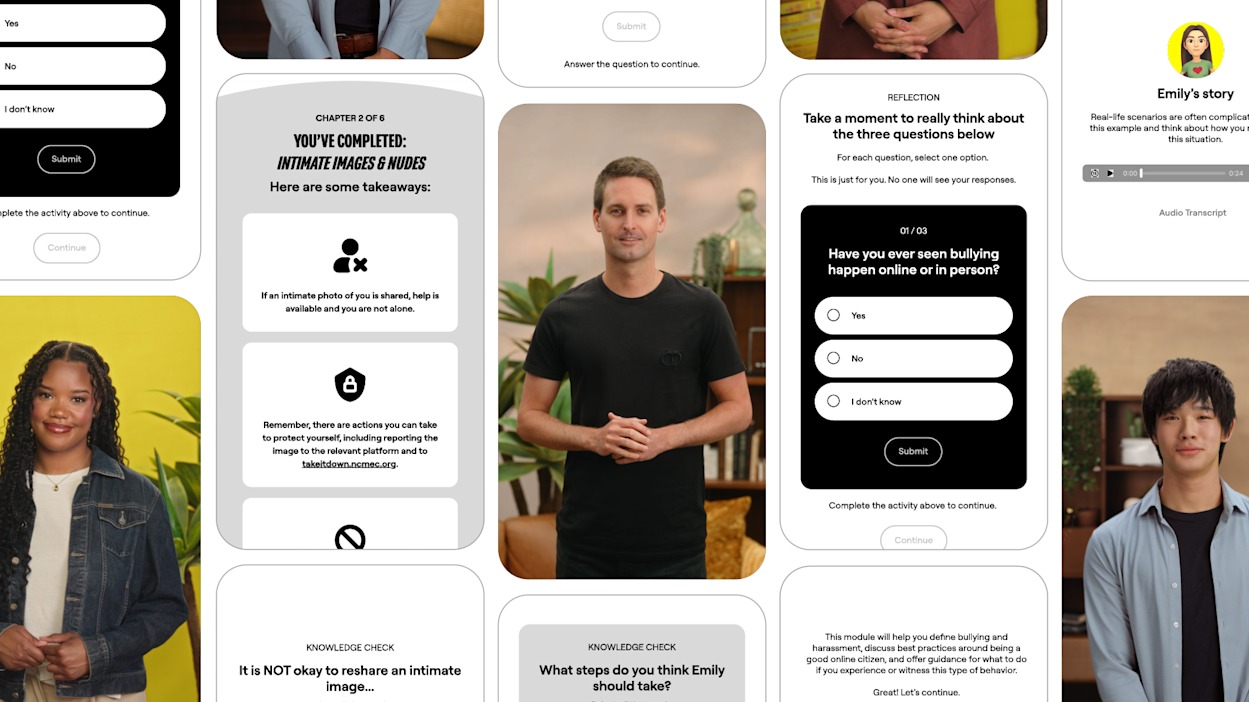
Last month, Snap and Common Sense Media teamed up to answer that with “The Keys: A Guide to Digital Safety.” It’s a 45-minute, interactive program that educates young people and their guardians how to make careful choices when communicating online. This time, teens and adults get in the driver’s seat together. Asking questions, discussing risks, and learning how to steer toward responsibility.
The first half of “The Keys” opens with a lesson in digital literacy, focusing on four common online dangers:
● Bullying & Harassment
● Intimate Images & Nudes
● Online Drug Activity & Fentanyl Poisoning
● Sextortion
Each topic begins with a video featuring a young person sharing their story (full disclosure, I’m one of them). Not a lecture, but a peer-to-peer message that teens may not only hear but actually listen to. It leads into audio reflections and quizzes, turning each lesson into a conversation. This guides young people to think critically about what they would do in similar situations. The Keys program can be paused or repeated anytime, just like Khan Academy.
The second half of The Keys is all about action, showing how Snapchat’s safety tools can be used to report and block. This practical guide is a reminder that digital safety isn’t only about avoiding danger. It’s about knowing how to protect ourselves and others.
Concerns about social media won’t vanish like Snaps do. Building a safer, kinder digital world requires platforms and users to develop skillbuilding, practice, and care.
“Key” Points:
● Awareness: Encouraging young people and guardians to take The Keys together.
● Action: Turning those lessons into habits. If you see online dangers occurring, play your part by using the Report Button.
● Alertness: Many online issues can be avoided by staying conscious of who and what you interact with. If someone you don’t know adds you, think twice before accepting.
Whether at school or at home, digital literacy can’t stop at handing out devices with a one-time warning. We need schools to adopt The Keys, and parents to reinforce it. These are the spaces where young people spend the most time online. Let’s make sure every teen learns not just how to drive on the internet, but how to do it kindly, safely, and with confidence.
Online, on guard.