


*Content Warning: If you or someone you know is struggling with thoughts of suicide, help is available 24/7. Call or text 988 for the Suicide & Crisis Lifeline, or text HOME to 741741 for the Crisis Text Line. You are not alone, and support is always there when you need it.
When I was 14, the person I was closest to made an attempt to end their life.
Because I was so close to her, I felt I should have seen it coming, and I continued to tell myself that for the longest time after while she worked hard to recover. I kept asking myself how I missed the signs. I went over our conversations again and again, looking for something I should have noticed: a phrase that meant more than I thought, or a mood I had disregarded as just a bad week. The question I couldn’t shake was: Why is it so hard to see this coming, even when you’re standing right next to it?
My experience, however, isn’t rare, and as you read this, you might think of your own story or a story you’ve head from another, as suicide touches so many lives. That’s part of why this topic is, at times, so hard to talk about, but also why we need to keep talking.
Like many young people who want to turn their passion into purpose, this experience is one reason I do the work I do now. As a research assistant in the CHOICES Youth Psychopathology & Treatment Lab, and having recently joined efforts at the Center for Suicide Research & Prevention at Mass General Brigham and Harvard University, I spend a great deal of my time contributing to suicide prevention research focused. My work spans conducting a structured literature review on evidence-based treatments for suicidal thoughts and self-injurious behaviors, organizing and coding clinical interview transcripts with adolescents for inter-coder reliability, and conducting regulatory folder checks on research protocols to ensure IRB compliance amongst building REDCap surveys. Between the data analysis side of this work and the administrative infrastructure that makes it possible, I’ve come to understand suicide prevention research as a full pipeline which directly shape whether findings can actually protect young people and helping me get closer to answering that important question I had at 14: what are the real signs, and, in our prevention efforts, how do we make sure the people closest to someone don’t have to find out too late? In learning from the research, I’ve seen that when we stay connected, we help ensure no one has to face their struggles alone.
Why Social Connection Matters in Suicide Prevention
September is Suicide Prevention Awareness Month, a time when mental health conversations become more visible and urgent. But for young people, these discussions can’t wait for just one month. Suicide is the second leading cause of death for people aged 15 to 34, and every statistic represents a young person who needed support, often before symptoms escalate. Suicide prevention is more than crisis intervention; it’s about building spaces where young people feel seen, connected, and valued before they ever reach a breaking point.
Quite notably, a 2024 CDC analysis of the Youth Risk Behavior Survey found that nearly 40% of high school students felt ongoing sadness or hopelessness, and 20% seriously considered suicide. The same analysis also identified that a range of protective factors, like school connectedness and parental monitoring, were associated with a lower prevalence of poor mental health and suicide-related outcomes. A 2024 study in the Journal of Child Psychology and Psychiatry followed 2,897 teens ages 12 to 17, recruited from 14 emergency departments across the country as part of the Emergency Department Screen for Teens at Risk for Suicide (ED-STARS) project. Researchers found that feeling connected to family, peers, and school lowers the likelihood of a suicide attempt, even for teens already at what is considered to be “high risk.” Another study using the National Longitudinal Study of Adolescent Health followed over 13,000 students in grades 7 through 12 who were surveyed twice at approximately 11 months apart. Researchers found that feeling connected to parents and family served as a protective factor against suicide attempts for Black, Hispanic, and White girls and boys alike. Further, having three protective factors present, family connectedness among them, reduced the risk of a suicide attempt by 70% to 85% across every racial and gender group studied, regardless of whether other risk factors were also present
Even still, peer relationships deserve more attention in prevention work as a whole. In support of this, a 2026 study on help-seeking and suicide prevention emphasizes that teens and young adults often talk to friends about emotional distress before turning to more formal support and resources, making peers effective “gatekeepers” in this work. Programs led by youth for youth that train young people to spot warning signs and start supportive conversations are more than a nice addition; they are integral parts of the overall prevention system.
This is where connectedness and suicide prevention go hand in hand. When young people feel truly connected to their peers, their communities, and supportive adults, they are more likely to reach out, stay involved, and build resilience for tough times. Suicide prevention happens every time a young person is reminded that their presence matters, and importantly, that they are not alone.
Building Social Connection in Suicide Prevention
Knowing how important social connection is in suicide prevention, the way we talk about mental health on a daily basis influences how we talk and think about suicide. Conscientious word choice matters, especially to young people. Research on youth perspectives on mental health stigma found that among adolescents, it isn’t what they believe about mental illness that determines whether they reach out for help, it’s what they think everyone else will think of them for admitting it. Perceived stigma, shaped by our everyday language, far outweighs the personal stigma. The words in a young person’s environment, the way their peers and communities talk about mental health, can matter more than their own private beliefs when it comes to whether they stay silent or speak up. Here are some language shifts we can all make to mitigate stigma:
With this context, this illustrates why saying someone “died by suicide” instead of “committed suicide” marks one of the largest and important shifts in how we discuss such a sensitive topic. Current language guides from mental health advocates detail how a word like “committed” borrows its weight from how we discuss crimes: you commit a robbery, a murder, or a sin. It frames suicide as an act of wrongdoing rather than an outcome of pain someone couldn’t carry any further. “Died by suicide,” however, is wording that recognizes this as a cause of death, not a moral shortcoming. The same extends to discussions of suicide attempts, as the addition of “failed” or “successful” before discussing attempts serve, unintentionally, to imply death as the desired outcome and survival as the failed counterpart. Coupled with advocacy, research, and involvement, using neutral, person-centered language (e.g. attempted suicide, made a suicide attempt, died by suicide) plays a large part in reducing stigma, encouraging help-seeking behavior and promoting respectful conversations about suicide.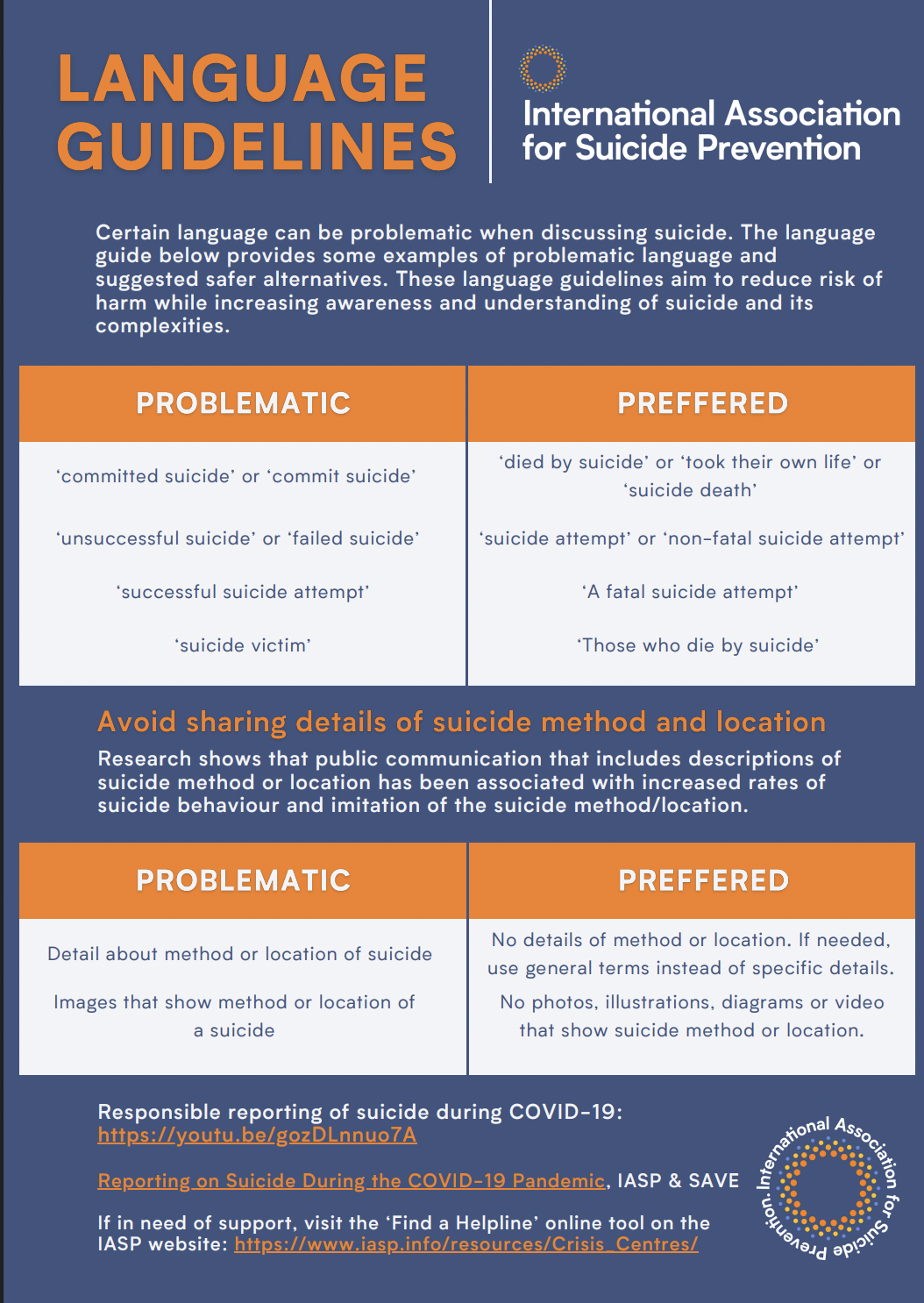
How to Take Part in Connection This Month: In Research, Advocacy & Beyond
Today, I move forward knowing that my younger self and the next 14-year-old like her will have a better chance of providing the connection someone needs, serving as a powerful form of suicide prevention through building genuine relationships and support. Taking action toward connection can also happen through research, advocacy, and community programs that drive suicide prevention forward.
- Crisis Text Line trains volunteers to support people in real time, and other well-known groups such as NAMI and The Trevor Project often invite young people to help shape programs, review materials, and advise on research priorities.
- Additionally, a variety of research labs also need youth participants for studies on risk assessment tools and interventions, so being part of the data is another way to contribute.
- Groups like the American Foundation for Suicide Prevention and the Suicide Prevention Resource Center share easy-to-read research summaries and often have local chapters looking for volunteers, not just donors.
- To generally build your support-based toolkit, the free, self-paced Be There Certificate teaches evidence-based skills for supporting someone who’s struggling, developed with youth mental health experts, and is a practical way to prepare for tough conversations.
- Programs like QPR (Question, Persuade, Refer) and Mental Health First Aid also teach warning-sign recognition in just a few hours.
- Additionally, your perspective as someone with lived experience is valuable data these fields need. Even amidst recent funding cuts, several departments in psychology, public health, and social work often run studies on adolescent mental health and suicide prevention and need research assistants for coding, literature review, or survey design. You can get in touch with faculty doing this work, even if you don’t feel “qualified” yet.
Besides individual opportunities, young people are working toward suicide prevention every day, developing sustained support systems and avenues for connection.
- Hope Squad is a student-led, peer-to-peer suicide prevention program in schools across the country. It trains students chosen by their classmates to spot signs of distress and connect peers to help and hope, not as bystanders but as trusted community members.
- Launched back in 2024, California’s Never a Bother campaign, focused on youth co-creation in a statewide suicide prevention effort. Young people’s work made a big impact, including through local youth-led Instagram campaigns like “Bother Me Wednesdays,” which created spaces for peers to share what they were going through.
- Youth MOVE National has built a youth-led network to transform mental health systems with lived experience at the center, because young people know that being consulted is not the same as being included.
- Mental Health America’s Youth Policy Accelerator is training new advocates to change the policies and systems that affect whether young people can get care.
- Young people working in peer crisis intervention through Youthline are certified in suicide intervention skills and answer the phone when someone needs to talk.
As September rolls around, Suicide Prevention Month makes clear that the future of prevention lies in the hands of young leaders willing to connect, listen, and advocate for change. Their courage to prioritize connectedness in leading difficult conversations, while continually meeting others with empathy and hope, remind us just how transformative an act of care can be. By following their example, we can all be part of a movement that turns connections into life-saving action, not just this month, but every day of the year.