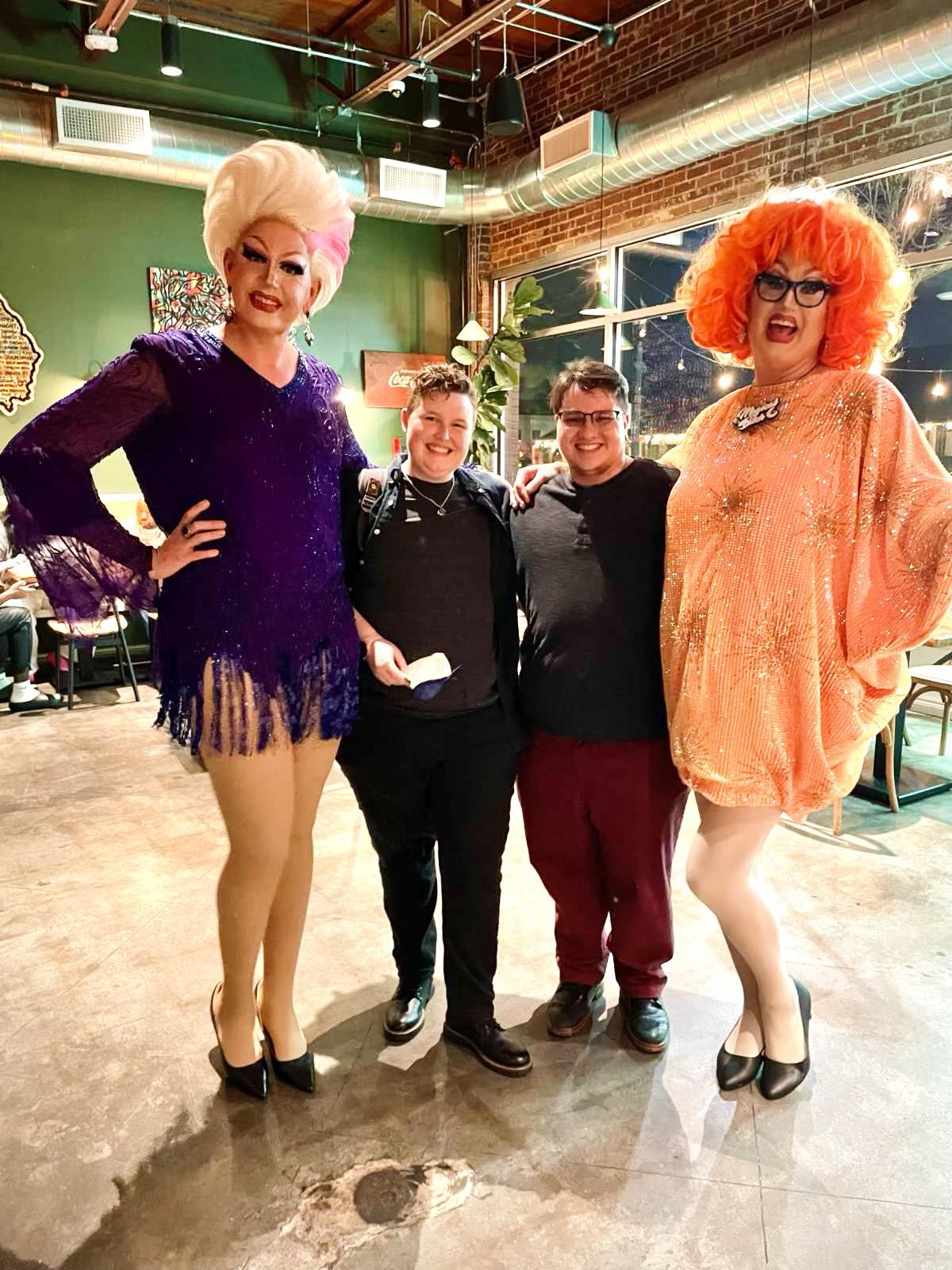
*This is the third story of our Trans Visibility Series, which centers the lived experiences of trans and gender-expansive young people while connecting those stories to relevant research and data. Read the previous story in our series here, and learn more about this series or to submit your own story, click here.
Hi, I’m Parker (They/Them), a genderqueer, demisexual person from Georgia, USA. Now, more than ever, the queer community, and especially the trans community, needs more visibility, love, and support.
We owe so much of the queer community’s progress in the fight for our rights to trans women, which is why I am thankful for the trans and nonbinary representation that RuPaul’s Drag Race now offers. The RuPaul’s Drag Race stage is a global platform for trans drag artists, to share their drag and represent the trans community. And even though the queens are in fierce competition with one another, they are always a community first and foremost. Having this representation of community is so meaningful to me personally because I don’t have a local queer community, or a supportive family. I haven’t met many queer people in my life, especially south of my nearest large city, Atlanta.
While Atlanta is very diverse, it is often inaccessible to me as a disabled person. In a survey conducted by CAP in partnership with NORC at the University of Chicago, out of 3,360 people, 1,703 of whom were LGBTQIA2S+, 48% of LGBTQIA2S+ respondents identified as disabled, while 70% of respondents who were trans considered themselves disabled.
Every season, queens from small towns across the country sashay across the Drag Race stage, many of which don’t have a supportive family, or many queer friends either. Almost overnight, these once small-town queens come to the show, meet other queens, and then get to travel the world! For instance, Trinity the Tuck, who grew up in Alabama, has spoken about feeling isolated as a young queer person. She was outed as gay by a cousin, which led to backlash from her family. However, since joining the Drag Race family, she has blossomed into who she was always meant to be, free of shame and guilt for being queer.
The isolation that Trinity the Tuck experienced is unfortunately far too common: many queer people from unsupportive towns and states have the desire to relocate to find community. A 2024 survey by The Trevor Project of more than 18,000 young trans people aged 13-24 across the U.S. found that 45% of transgender and nonbinary young people reported that they or their family have considered moving to a different state because of LGBTQIA2S+ related politics and laws. The Trevor Project’s 2024 U.S. National Survey on the Mental Health of Young People in Georgia found that as many as 61% of transgender and nonbinary young people or their families reported considering leaving Georgia for another state. And 59% of LGBTQIA2S+ young people
in Georgia experienced discrimination based on their sexual orientation or gender identity in the past year. There have also been elevated levels of anxiety and depression, between 58% and 71% of young trans respondents struggled with anxiety and depression in Georgia. None of these statistics are coincidences. Across the country, since 2021, at least 3,443 anti-trans bills have been introduced, and so far, 358 of them have been passed to become law.
Young trans people often rely on the internet for connection and acceptance (up to 73%), and while social media can offer community, hope, and inspiration, it is also often the source of polarizing content and an endless stream of devastating anti-trans news and policy. Because of this, it’s easy to feel like the whole world is against you, especially when you’re one of the only queer people in your circle offline, and you see the constant bombardment of bills that lawmakers are practically burning rubber in a drag race of their own to see how fast they can take away as many of our hard-earned rights as possible. The statistics only emphasize just how important representation and community truly are, and always have been. Without Drag Race and other queer (or queer-coded) characters on TV and in the media, it would be easy to feel even more isolated in small, conservative towns.
I don’t drink alcohol, and alcoholic beverages are frequently served at queer events, which makes it difficult to feel welcome in those spaces, even when they’re overwhelmingly queer. The lack of queer community has impacted my mental health negatively. Like Trinity the Tuck, I feel isolated, especially when queer events are not only far away, but masks aren’t recommended or required. In 2020, The National Disability Institution surveyed over 600 disabled people to gauge their thoughts and worries about the growing pandemic. 55% of the respondents were concerned about social isolation. That number has likely only increased, as most places have stopped taking any COVID precautions, and sometimes you get weird looks when you’re the only one masking in a space, so a lot of disabled people, like myself, choose to stay home for safety.
In 2025, in the UK, The Business of Events and ICC Wales conducted research to find out how many disabled people had accessibility issues when accessing events. 93% of disabled respondents said they ran into accessibility issues, and that it created barriers to accessing events. Although this research was conducted in the UK, accessibility issues are just as prevalent in the US, and when queer-friendly spaces are already hard to come by, finding accessible queer-friendly spaces can feel almost impossible. As a disabled person, Drag Race gives me a window to an otherwise inaccessible world to see so many beautiful, queer people, who because they have found their community, are thriving.
Whenever I feel like I won’t ever have the queer support and community I’ve been yearning for, Drag Race helps to fill that gap by reminding me that the world is so much bigger than my small town. I may not be able to have the queer community I desire until I can leave Georgia, but Drag Race is a good reminder that no matter where you grew up or how you’ve been treated, you deserve to feel accepted and loved for who you are, regardless of your identity.
Wigloose, my favorite Drag Race Rusical, taught me that when the queer community, and drag artists band together, we thrive together. Just because the queer community is misunderstood, doesn’t mean we should be feared. But, just like the Wigloose cast sang sarcastically in the song, Black and White: ‘The point is, anything different is scary, so it must be wrong’, hence why the citizens of the fictitious town of West Bumtuck, U.S.A. vote to abolish drag forever.
Despite being feared and misunderstood, queer people and drag artists everywhere continue to spread love and positivity. Even when the whole world is against us, we cannot lose our hope and tender-loving hearts that we need in order to continue marching toward queer liberation. As the cast sang in Built on Drag: ‘Drag is a fight, drag is a protest, drag only reveals who you really are. If you want to shine, I’m letting you know this: the kind of love we grow can’t grow in the dark.’
I’m so grateful that the queer community has a global platform like RuPaul’s Drag Race to showcase just how beautiful, kind, loving, and free the queer community is, but it doesn’t stop with just Drag Race. King of Drag, which featured queer women, nonbinary, and trans drag kings, debuted in 2025 on Revry (season 2 coming fall 2026). Support local drag and remember that no matter how much anyone tries to attack our community, we will be here, and we will be queer, so get used to it! Sending love to all of my trans siblings, whether you’re out, closeted, or questioning. You belong, forever and always!